
Rapé: The Sacred Snuff of the Amazon Rainforest
Share
Deep within the Amazon rainforest, long before the modern world began cataloguing plant medicines, indigenous tribes were perfecting a sacred practice: the use of Rapé (pronounced ha-peh), also written as Hapé or Hapeh. This finely ground medicinal snuff has been central to Amazonian spiritual life for centuries — used for healing, ceremony, grounding, and direct communication with the plant kingdom.
Today, Rapé is gaining recognition beyond the rainforest. Practitioners of plant medicine, meditation facilitators, and seekers of natural wellness around the world are discovering what Amazonian tribes have always known: this sacred snuff is far more than mapacho. It is a complete system of energetic, physical, and spiritual medicine.
This guide covers everything — what Rapé is, where it comes from, how it's made, its benefits, how to use it, and how to choose the right blend for your path.
Explore Authentic Amazonian Rapé
All blends sourced directly from indigenous tribes in Brazil — ethically traded, ceremonially prepared.
Browse the Hapé Collection →What Is Rapé?
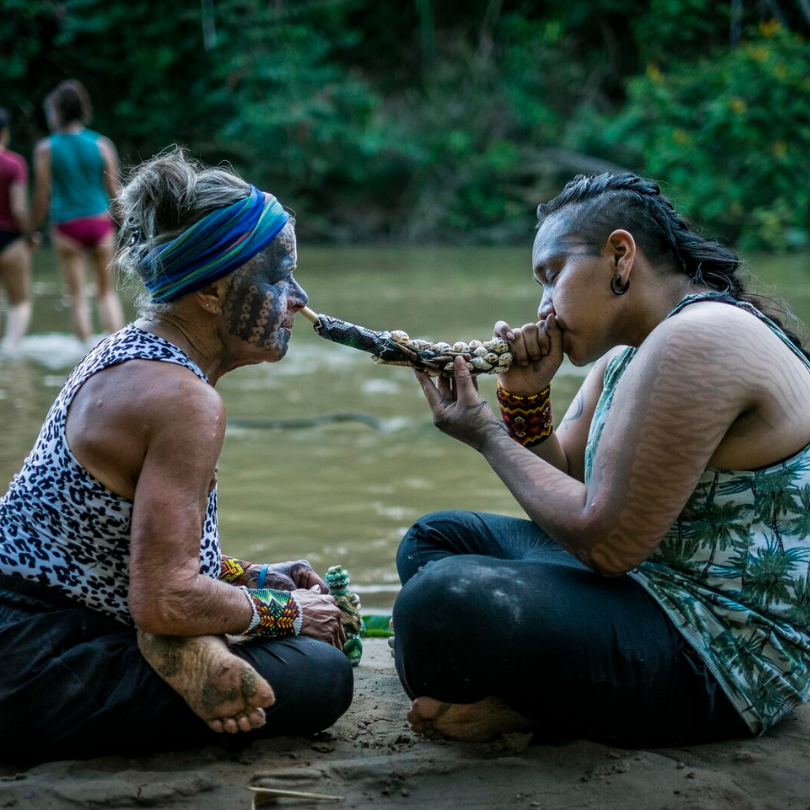
Rapé is a sacred, powdered snuff made primarily from Nicotiana rustica — a wild mapacho species far more potent than commercial nicotine products — combined with the ash of specific Amazonian trees and a selection of medicinal plants. Unlike commercial nicotine products, Rapé is not smoked. It is insufflated (blown) into the nostrils through a V-shaped pipe called a Tepi (administered by another person) or a Kuripe (a self-applicator shaped like an elbow pipe).
The experience is immediate and intense. A gentle wave of grounding energy moves through the body, the mind becomes still, and the noise of everyday thinking clears. Many users describe it as a reset — a return to the present moment, stripped of mental chatter.
Each blend is unique. The specific combination of mapacho, ash, and medicinal plants varies by tribe and by intention — some blends are soft and expansive, others are deeply purging and clarifying. Understanding this range is key to working with Rapé skillfully.
Origins: Which Tribes Use Rapé?
Rapé is not the practice of a single tribe — it is woven across dozens of indigenous nations throughout the Amazon basin, each with their own formulations, protocols, and ceremonial contexts. The most prominent among them:
Huni Kuin (Kaxinawá)
One of the largest and most well-known Amazonian peoples, the Huni Kuin of Acre, Brazil have preserved their Rapé traditions with extraordinary care. Their blends are often made with Tsunu ash — from the bark of the Tsunu tree — combined with wild mapacho. Huni Kuin Rapé is known for its clarity-inducing and deeply grounding qualities.
Yawanawá
The Yawanawá people of the Juruá River region produce some of the most respected Rapé blends in the world. Their Tsunu and Samauma Flower blends carry the energy of their deep forest homeland. The Yawanawá are also known for their integration of feminine energy into their medicines, producing blends that open the heart as much as they clear the mind.
Nukini
The Nukini tribe produces distinctive Rapé blends including their celebrated 7 Estrelas (7 Stars) formula — a blend combining multiple medicinal plants for layered effect. Nukini medicines carry a reputation for deep spiritual opening and ancestral connection.
Kuntanawa
The Kuntanawa, known as the "People of the Cane," produce Rapé with a strong focus on healing and grounding. Their Copaiba Hapé — infused with the resin of the Copaiba tree — is prized for its anti-inflammatory and calming properties.
Katukina
The Katukina people are considered by many to be the original keepers of Rapé tradition. Their blends are often described as among the most powerful and purifying available, working swiftly to clear energetic blockages and restore physical vitality.
Shawadawa
The Shawadawa (Arara) of the Juruá valley are known for producing Rapé with particularly strong spiritual properties. Their Kapayuba blend is one of the most sought-after on the market for its ability to facilitate deep focus and ceremonial connection.
New to Rapé? Start with a Sample Set
Try blends from multiple tribes and find what resonates with your practice before committing to a full quantity.
Shop the Sample Set →How Rapé Is Made
The production of authentic Rapé is a sacred process, not a manufacturing one. Every step carries intention.
Step 1 — Harvesting the mapacho. Wild Nicotiana rustica is harvested by hand and sun-dried over several days. This variety contains significantly higher concentrations of nicotine and other alkaloids than commercial nicotine products, giving Rapé its distinctive physiological effect.
Step 2 — Making the ash. Specific tree barks — most commonly Tsunu, Paicá, Canela de Velho, or Samauma — are burned and their ash is carefully collected. This ash is not incidental. It is a principal active ingredient, contributing alkalinity that affects how the mapacho alkaloids are absorbed and also carrying its own medicinal properties.
Step 3 — Grinding. The dried mapacho and ash are ground together — traditionally by hand using a mortar and pestle — into an extremely fine powder. This process can take hours. The fineness of the grind determines the quality of the medicine. Coarse Rapé is a sign of poor preparation.
Step 4 — Adding medicinal plants. At this stage, the tribe-specific plants are incorporated. These may include dried flowers, resins, seeds, roots, or additional tree barks. Each addition shifts the medicine's energetic profile — some plants calm, some activate, some open the heart, some sharpen focus.
Step 5 — Prayer and intention. Authentic tribal Rapé is made with prayer. The intentions of the maker are considered inseparable from the medicine itself. This is why sourcing from tribes directly — rather than from intermediaries who repackage — matters deeply.
The Benefits of Rapé: Physical, Mental & Spiritual
Physical Benefits
- Sinus clearing: The insufflation process physically clears the nasal passages, which many users find beneficial for respiratory health and congestion.
- Grounding the nervous system: The alkaloids in Nicotiana rustica have a rapid grounding effect on the sympathetic nervous system, reducing anxiety and hyperactivation.
- Purging: In stronger blends, Rapé can induce a physical purge (nausea, tears, mucus release). This is considered deeply cleansing and is welcomed in ceremonial contexts, not feared.
- Headache relief: Several tribes traditionally use Rapé specifically for headaches and sinus pressure, with rapid results.
Mental Benefits
- Clarity and focus: One of the most consistent effects reported across all blends is the silencing of mental noise and the emergence of sharp, present-moment clarity.
- Breaking mental loops: Rapé is particularly useful for interrupting anxious or repetitive thought patterns that meditation alone may not reach.
- Intention setting: Many practitioners use Rapé at the opening of a meditation or ceremony to sharpen their focus on a specific intention before entering deeper states.
Spiritual Benefits
- Energetic clearing: Indigenous traditions understand Rapé as a tool for removing heavy or stagnant energies from the body's field — what some traditions call negative entities or thought-forms.
- Ancestral connection: Several tribal traditions specifically work with Rapé to open communication with ancestors and plant spirits.
- Heart opening: Blends containing Bobinsana, Samauma Flower, or certain resins are known for softening the emotional body, creating states of warmth and compassion.
- Protection: Many tribes use Rapé as a protective medicine before entering ceremonial space, establishing a clear energetic boundary.
Rapé Strengths: Finding the Right Blend
Not all Rapé is the same intensity, and choosing the right strength is essential — especially for beginners. At Altar Origin, we organize our collection by strength to make this easier.
Soft / Gentle Blends — Ideal for beginners, daily meditation practice, or those with nicotine sensitivity. Effects are subtle: light grounding, gentle mental clearing, warmth in the chest. Great entry points include Kuntanawa Copaiba and Samauma Flower blends.
Medium Strength Blends — The core of most regular practitioners' rotation. Noticeable grounding, stronger mental clarity, some physical intensity in the sinuses. Caboclo Paicá and Kuntanawa Samauma are popular in this range.
Strong / High Strength Blends — For experienced users seeking deeper work. Strong physical purging is common. The Nukini 7 Estrelas, Shawadawa Kapayuba, and Tsunu Forte fall in this category. Not recommended as first experiences.
See our full Hapé Strength Guide for a complete breakdown with recommendations by intention and experience level.
How to Use Rapé
Rapé is administered through the nostrils using a blowpipe. There are two tools:
The Tepi is a long pipe used by one person to administer Rapé to another. The practitioner blows through one end while the other end is placed in the recipient's nostril. This is the traditional ceremonial method and is considered more powerful because the practitioner's breath carries their own energy into the medicine.
The Kuripe is a V-shaped self-applicator that allows you to administer Rapé to yourself. One end goes in the mouth, the other in the nostril. The user blows with a firm, single breath. This is the most practical tool for solo practice.
General protocol:
- Set a clear intention before use. Know what you are calling in or releasing.
- Sit upright, spine straight. Do not lie down.
- Load a small amount (a pinch the size of a pea is enough for beginners) into the pipe.
- Apply to the left nostril first, then the right.
- After application, breathe slowly through the mouth. Resist the urge to blow your nose immediately — allow the medicine time to work.
- Sit in stillness for 10–20 minutes. Let any purging or emotion move through without resistance.
Everything You Need to Begin
Kuripe self-applicators, ethically sourced hapé blends, and starter kits — all in one place.
How to Source Rapé Ethically
As Rapé gains global attention, the market has become flooded with blends of unknown origin — often produced outside of tribal communities, sometimes adulterated, sometimes misrepresented. For a medicine this sacred, sourcing matters on every level: ethically, spiritually, and practically.
What to look for when choosing a Rapé supplier:
- Direct tribal sourcing: The supplier should be able to name the specific tribe and ideally the region or community of origin for each blend.
- Transparency about ingredients: Authentic Rapé contains mapacho, ash, and medicinal plants — nothing synthetic. If a supplier cannot tell you what's in it, move on.
- Fair trade relationships: Look for suppliers who pay indigenous communities fairly and maintain ongoing relationships, not extractive one-time purchases.
- No mass production: Rapé made at scale by machines loses both its energetic integrity and its quality. Small-batch, hand-ground preparation is the standard of authentic medicine.
At Altar Origin, every blend we carry is sourced directly from indigenous communities in Brazil through relationships built on respect and fair compensation. We know the tribes, we know the blends, and we stand fully behind the integrity of what we offer.
Frequently Asked Questions
Is Rapé legal?
Yes. Rapé is legal in the United States, Canada, and most of the world. It is a plant medicine, not a controlled substance. Always verify the regulations in your specific country or region before ordering.
Is Rapé addictive?
Used ceremonially and with intention, the risk of dependency is low. However, because it contains mapacho, daily habitual use can create nicotine dependence. Rapé is a ceremonial medicine, not a daily supplement — treat it as such.
Can I use Rapé if I'm sensitive to mapacho?
Start with a very small amount of a soft blend and proceed slowly. Many people who are sensitive to smoked nicotine products tolerate Rapé differently because it is not combusted. That said, if you have serious respiratory conditions or nicotine sensitivity, consult a healthcare professional first.
How often should I use Rapé?
Most experienced practitioners work with Rapé once or twice per week, often in a dedicated meditation or ceremony context. Daily use is generally not recommended for ongoing practice.
Conclusion
Rapé is one of the most direct and powerful plant medicines accessible to people outside of Amazonian ceremonial contexts. Its ability to ground the body, silence the mind, and open the spirit within minutes — without the length or intensity of longer ceremonies — makes it uniquely practical for modern seekers.
But it deserves to be approached with the reverence it was given by the tribes who developed it over generations. Work with intention. Source ethically. Start gently. And allow the medicine to teach you what it has taught indigenous Amazonians for centuries: that the plants are listening, and the forest has medicine for what ails you.
Browse our full collection of ethically sourced Rapé blends from the Huni Kuin, Yawanawá, Nukini, Kuntanawa, Shawadawa, and Katukina tribes at Altar Origin.


